Compliance,
monitored remotely.
Every Sage central battery system tests itself on a 28-day cycle, logs what it found, and emails the facility team the moment something fails. Here is exactly what it watches, and exactly what it tells you, walked on the 42,000 square foot reference design.
Your login, your building.
The dashboard is Sage’s own platform, not a mock. Sign in with Google or Microsoft, or a one-time email link. No passwords to manage. The whole building at a glance: test records, fault alerts, and the record behind every result. Shown here with demo data on the 42,000 square foot reference design.
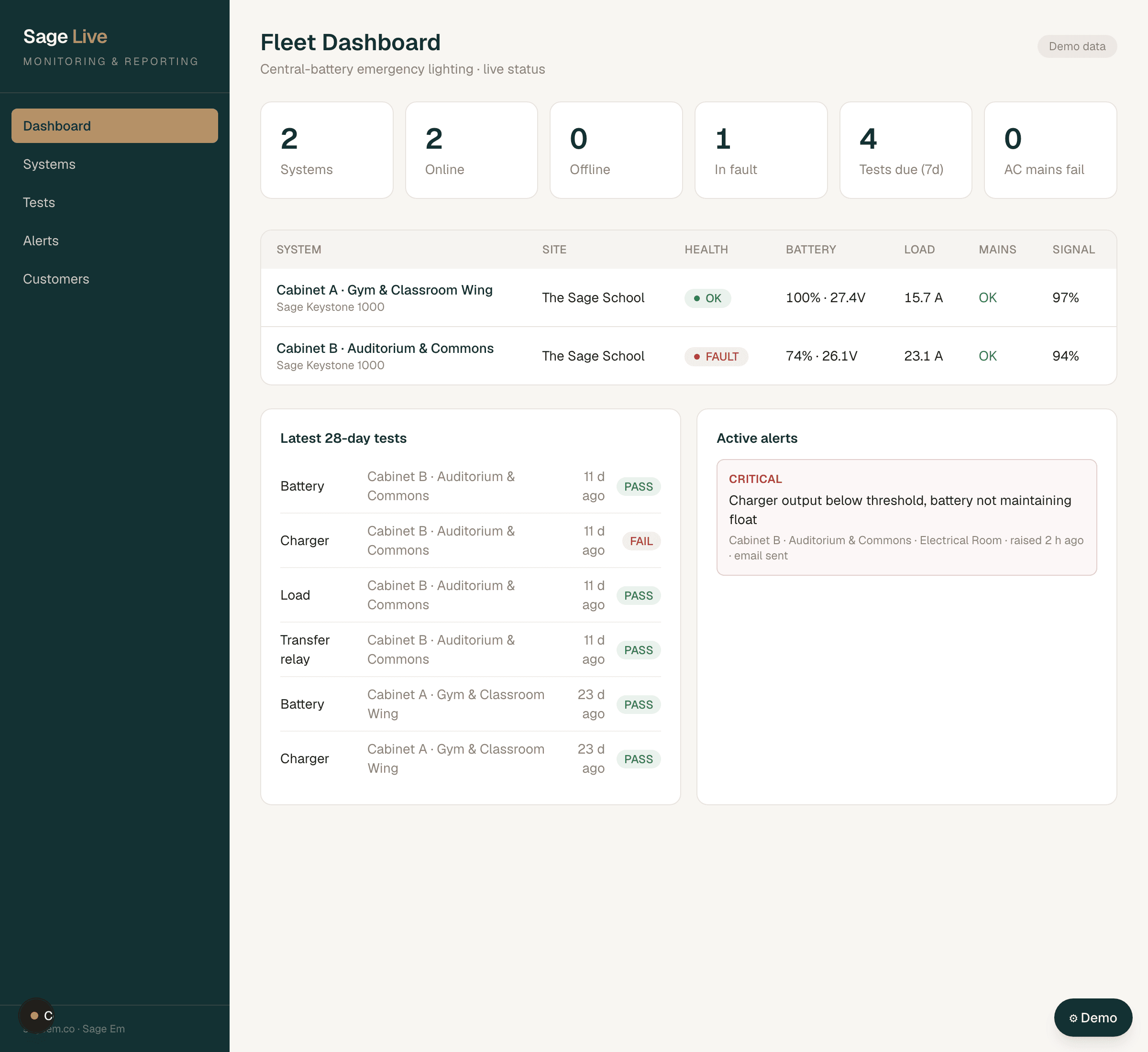
Four categories, graded on a 28-day cycle.
The cabinet is the thing under test. It exercises itself and grades the result, so nobody walks the building with a clipboard to find out whether the emergency lighting still works.
Voltage and temperature on each battery in the cabinet, sampled continuously and graded on the cycle.
That the computer-controlled charger is holding the batteries at float, not drifting or overcharging.
That the emergency load the cabinet is carrying matches the load it was designed and sized for.
That the transfer actually operates, exercised on the cycle rather than assumed until an outage proves otherwise.
Monitoring reports at the circuit.
When something fails, the email names the circuit, the zone and the cabinet. That is the honest granularity of the system, and it is what arrives in the facility team’s inbox the moment the fault raises rather than at the next inspection.

Service teams walk one circuit. Not the whole building.
A circuit is not a vague answer, because Sage engineered the layout. The submittal package already documents every emergency fixture on every circuit, by location. A fault on one circuit narrows the search to the handful of fixtures on that run.
On the reference design that is 87 relay-converted emergency fixtures and 24 exit signs, 111 emergency points in total, fed from 2 cabinets. The monitoring tells the facility team which circuit; the design package tells them which fixtures sit on it.
That pairing is the part a competitor cannot copy. It needs the design and the monitoring to come from the same place. Compare it to integral battery packs, where nobody knows a fixture has failed until the monthly walk-through catches it weeks later, or an occupant notices a dark fixture during egress.
Eleven monthly tests and one annual, logged as they happen.
The 30-second monthly check and the 90-minute annual full-burn run on schedule without anyone attending them, and each one writes itself into the record with its date and its result. The facility team stops maintaining a binder, and the compliance history is there when the AHJ asks for it.